
Crannogs Project
Introduction
Project lead: Richard Guest guestcharles1@gmail.com.
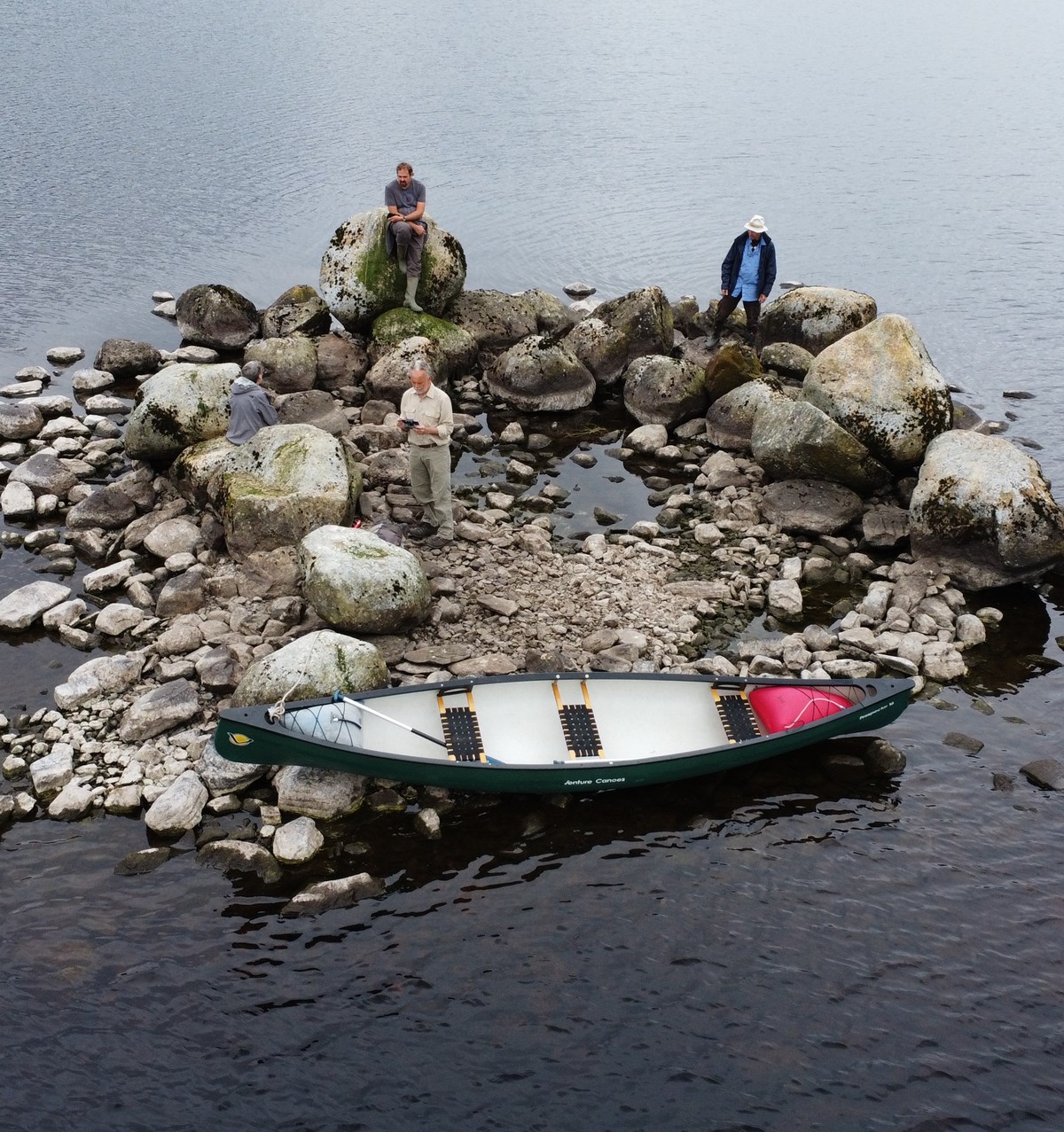
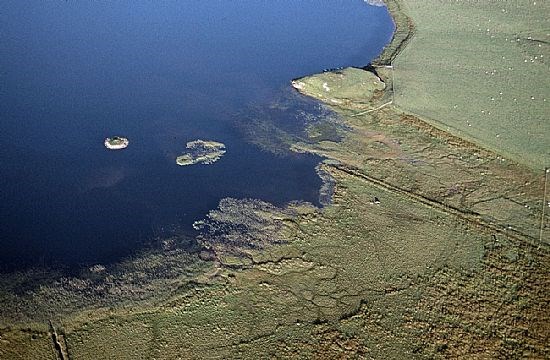
The project aim is to build up a database of the location of crannogs in the Highlands and to investigate a select few in greater detail. For the purpose of this exercise, we are defining crannogs as small islands in freshwater lochs which are entirely or partially man made. There is no maximum or minimum size but as a rule, think of a big hut circle surrounded by water. Changes in water level over time may make the crannog appear larger or smaller than its original size. They are typically circular or ovoid and consist of a pile of rocks of fairly uniform size, no bigger than a two-man lift. There has been very little investigation since antiquarian times and there is almost no hard dating evidence for any of them.
The first phase of the project was to carry out a desktop study with the intention of identifying small islands which appeared as though they might be crannogs but were not on the archaeological record. Next, we undertook field study to visit potential unrecorded crannogs to verify the desktop findings and if appropriate, update the record. The field study phase is well underway, with just a handful of sites identified so far still to be visited. We also visited a number of recorded crannogs to identify suitable sites for more in-depth investigation, particularly underwater, in the hope that it would be possible to establish firm scientific dates.
A report on the findings of the desktop study and fieldwork can be found here. Information on the sites visited, as well as locations of recorded crannogs, can be found on a webmap here.
Loch Achilty Crannog was chosen for further investigation and excavation took place in September 2025.
Desktop Study
The study was based on Ordnance Survey grid squares. An area of the mainland of the Highlands was studied, extending southwards from a line running roughly from Ullapool in the west to Golspie in the east, down to a line running through Loch Sunart, Loch Leven and the Blackwater reservoir. The western limit was the mainland coast, and the eastern limit was roughly the Highlands administrative boundary just east of Nairn and Aviemore. In all, an area of 1,860 sq km was studied by 26 volunteers, most but not all of whom were NOSAS members. From satellite imagery the volunteers identified about 340 small islands which could potentially be crannogs. The steering group identified 57 of these for further study and from these, 35 were chosen to be visited on site. In February 2026 it was decided to continue the study northwards to cover the remainder of the Highland mainland.
Site Visits
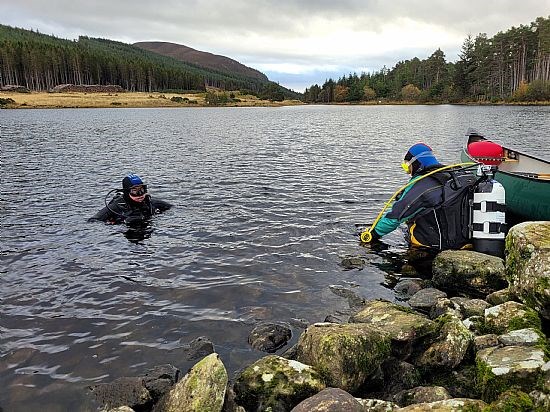
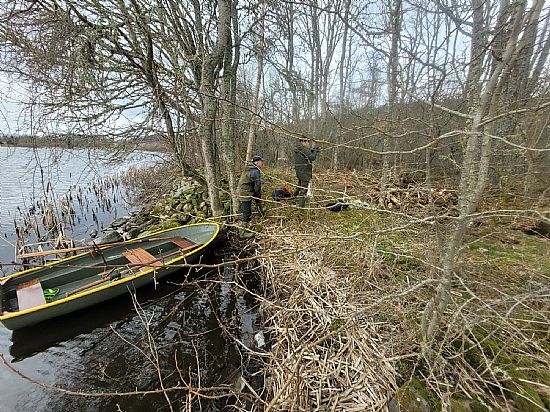
Initially the sites were viewed from shore, and it was possible to eliminate most of them as natural islands, just by looking from shore. 8 sites required an underwater exploration, accomplished by scuba diving or snorkelling. 3 recorded crannogs were examined under water by divers, and one was visited by wild swimmers. All the potential unrecorded sites, and one of the recorded crannogs, were judged to be natural islands.
The desktop study completed so far has therefore failed to find a single unrecorded crannog and for this reason it was not continued northwards. However no work has been done in the northern highlands, or Moidart and Ardgour south of Loch Sunart. In the light of ad-hoc discoveries further north, this omission is now being rectified.
Loch Kinellan Crannog
Kinellan was identified as a site of particular interest. It was excavated in antiquarian times and the report in PSAS is one of the most thorough and scientific to be done in that era. The island consists almost entirely of organic material, with several well stratified layers of brushwood, timbers, clay and habitation layers with charcoal, hazelnuts and animal bone. Some mediaeval pottery was found. Re-opening one of the old trenches (which were well mapped at the time and are still evident on site) could make it possible to obtain dateable material through the whole sequence of occupation. However, digging the site would require scheduled monument consent and, after consultation with Historic Environment Scotland, it was clear that consent was unlikely to be granted so it has been decided not to pursue this at the current time.
Loch Achilty Crannog
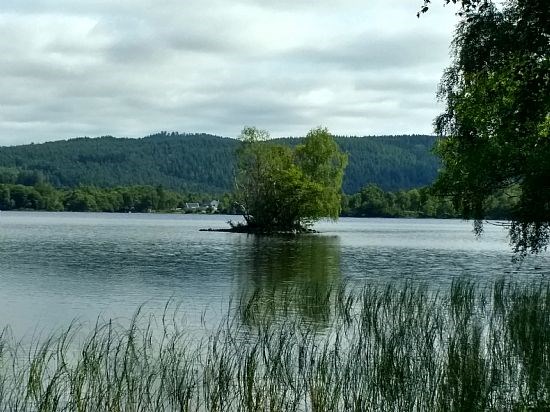
This crannog has proved to be the most interesting we have investigated. An initial snorkel examination was sufficient to establish that it was an artificial island, and several timbers could be seen. A scuba diving survey followed, and over the course of several dives, a topographical survey of the island both above and below water was completed. Samples taken from two timbers embedded in the stone mound were submitted for carbon dating. These have yielded dates of AD 1046 – 1221 and AD 1323 – 1421, suggesting it is of mediaeval construction. A DES report has been submitted on the findings so far and this can be viewed here.
In partnership with the Nautical Archaeology Society (NAS), and with guidance from Michael Stratigos of Aberdeen University, an underwater excavation was carried out in September 2025. We hoped to establish how the crannog was built, whether there is evidence of occupation, and whether we can obtain additional datable material to give us a full chronology of the site. We also carried out sonar imaging to obtain a 3-D model of the crannog and to search for any other submerged features in the loch which may be crannogs. Funding was obtained from The Society of Antiquaries of Scotland and from SSE Renewables, to allow the project to proceed, with volunteers from both NOSAS and NAS carrying out much of the work.
The project was very successful. Two underwater structures were discovered by sonar survey and examined by divers and they do appear to be potential new crannogs. Excavations revealed timbers which were sampled for dendrochronology and numerous samples of organic material have been collected for radiocarbon dating and paleoenvironmental analysis. A Post Excavation Research Design is being prepared.
A full report on the excavation will be produced in due course.
The above Interactive Webmap (direct link here) was produced by Bob Jones in 2025. A handy guide to the map can be downloaded here.
The webmap was created using QGIS Cloud (a powerful Web-GIS platform for publishing maps, data and services on the internet). For more infomation on QGIS Cloud visit https://qgiscloud.com/